Don’t Skip the IAQ Conversation

You ran 20 service calls last week. At least half of them had air quality issues the homeowner didn’t even know about — musty smells they’d gone nose-blind to, dust buildup on coils that tells a bigger story, humidity levels silently feeding mold behind drywall.

But here’s the question: how many of those calls turned into an IAQ conversation? And of those conversations, how many turned into conversions?

For most contractors, the answer is uncomfortable. Not because they don’t care about air quality — but because they don’t have a simple, repeatable way to bring it up without sounding like they’re upselling.

That’s the real problem. And it’s costing you more than you think.

The Hidden Cost of Skipping the IAQ Conversation

If you run 15–20 service calls per week and only convert 1–2 into an IAQ add-on, you’re leaving significant money on the table. Entry-level IAQ solutions sell for $300–$500 installed. Mid-tier systems run $500–$800. Premium whole-home solutions can clear $1,000+.

Even if you only converted 3 more IAQ add-ons per week at an average of $500, that’s $6,000/month in revenue from work you’re already at the house to do. No additional lead cost. No extra truck roll. No new customer acquisition.

So why doesn’t it happen?

Because most technicians don’t have a framework that makes the conversation feel natural — like a diagnostic recommendation rather than a sales pitch. When you walk in with one product at one price, the customer’s only choice is yes or no. And “no” wins most of the time.

The Reframe: IAQ Isn’t an Upsell — It’s Part of the Diagnosis

Here’s the shift in thinking: you’re not pitching a product. You’re completing the diagnosis.

When you assess a system, you already look at airflow, refrigerant levels, electrical connections, and mechanical wear. Indoor air quality is the piece most contractors skip — not because it doesn’t matter, but because they don’t have a structured way to present it.

The Vive IAQ Good-Better-Best framework gives you that structure. Three tiers. Clear differentiation. A natural way to say: “Based on what I’m seeing in this home, here’s what I’d recommend — and here are your options.”

No pressure. Just a professional completing the picture.

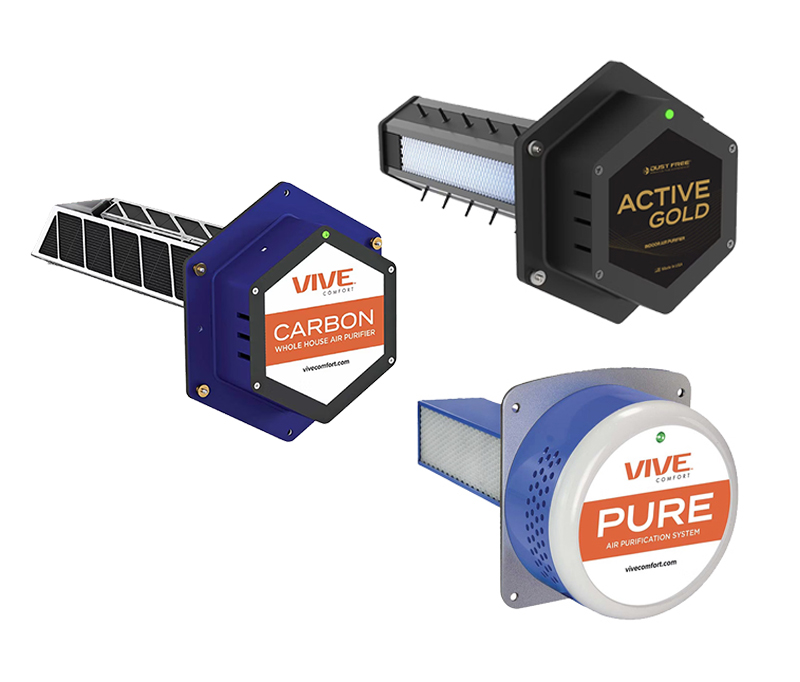
Good: Vive™ Carbon Air Purifier — The Diagnostic Starting Point

When to recommend it: The home smells stale. The homeowner mentions odors. You can see buildup on the coil. They’re budget-conscious but open to improvement.

The Carbon Air Purifier is your entry-level recommendation for homes that need cleaner air without a complicated conversation or installation. It mounts in the duct, uses a proprietary Carbon/UV-C multi-stage technology to target VOCs (including formaldehyde), bacteria on coils, and everyday odors.

Why it works in the field:

  • Compact, duct-mounted — add it to virtually any service call without significant labor
  • UL 2998 tested, zero ozone emissions — recommend with confidence
  • 24V auxiliary power port — if the customer wants to add germicidal UV later, the door is already open
  • No complicated explanation needed: “This targets the odors and compounds that make your air feel stale.”

The conversation: “Based on what I’m seeing on your coil and what you’re describing with odors, I’d recommend at minimum adding an air purifier to your system. This is the most straightforward option — it mounts in your ductwork, targets the VOCs and odors you’re smelling, and requires virtually no maintenance.”

Better: Vive™ Pure Air Purification System — For the Customer Who Asks “What Else Can We Do?”

When to recommend it: Allergy sufferers in the home. Pets. A newer, well-insulated house where reduced air exchange is concentrating pollutants. The homeowner who says “I want better air — not just less odor.”

The Pure Air Purification System steps up to UV purification technology that reduces offensive air pollutants and inactivates bacteria — not just masking symptoms, but addressing broader air quality concerns.

Why it works in the field:

  • Engineered for today’s high-SEER systems — keeps pace with modern, airtight homes
  • Expanded range ballast for increased electrical reliability — fewer callbacks
  • UL 2998 tested, zero ozone
  • Same clean installation profile — 24V aux port, highest-quality construction

The conversation: “You mentioned your daughter’s allergies have been worse since you sealed up the house last year. That tracks — tighter homes trap more of what you’re trying to keep out. The Pure system is designed specifically for newer, efficient homes like yours. It doesn’t just reduce odors — it actively purifies the air moving through your system.”

Why this tier matters: In modern, well-insulated homes, the air exchange rate drops significantly. Homeowners invested in efficiency without realizing they created a sealed environment where pollutants concentrate. This isn’t something most homeowners connect to their HVAC system — but you can.

Best: Vive™ Active Gold Indoor Air Purifier — The Whole-Home Commitment

When to recommend it: High humidity environments. Coastal installs. Homeowners with respiratory conditions, young children, or aging family members. The customer who says “I want the best you’ve got.”

The Active Gold combines three proven IAQ technologies in one unit:

  • Carbon fiber ionizers — actively charge and remove airborne particles
  • Germicidal UV — inactivates biological contaminants at the source
  • Photocatalysts — break down VOCs and odors at a molecular level

This isn’t addressing one category of concern — it’s addressing virtually all of them simultaneously.

Why it works in the field:

  • Corrosion-resistant materials — built for humidity, salt, and temperature extremes
  • UL 2998 + CARB certified — the highest regulatory bar in the industry
  • Twist-lock power cord, gasket-sealed mounting plate — professional install, clean finish
  • 3000V surge protection — reliable in variable electrical environments
  • Made in the USA

The conversation: “Given the humidity levels I’m reading in this home, and what you’ve told me about your wife’s respiratory concerns, I’d recommend going with the Active Gold. It’s three technologies working together — ionization, UV, and photocatalytic oxidation — so it’s not just filtering, it’s actively breaking down contaminants. And the corrosion-resistant build means it’s going to hold up in this climate.”

Quick Reference: Matching the Solution to the Call

Good Better Best
Product Carbon Air Purifier Pure Air Purification System Active Gold
The Trigger Odors, stale air, coil buildup Allergies, pets, tight homes Respiratory concerns, humidity, coastal
What It Targets VOCs, odors, coil bacteria Broader pollutants + bacteria Particles + biologicals + VOCs simultaneously
Ozone-Free ✓ UL 2998 ✓ UL 2998 ✓ UL 2998 + CARB
Aux 24V Port

The Real Insight: You’re Already in the Home

This is the part most contractors miss.

You don’t need a new marketing campaign to sell IAQ. You don’t need new leads. You don’t need a mailer or a Facebook ad. You’re already standing in the home, trusted, with the system open in front of you.

The opportunity isn’t acquiring new customers — it’s completing the service for the ones you already have. Every service call where you don’t assess and address air quality is a call where you left revenue behind and left the homeowner with a problem they didn’t know you could solve.

The Good-Better-Best framework makes it simple:

  • Diagnose the air quality concern (you’re already seeing the signs)
  • Recommend the appropriate tier based on the home and the homeowner
  • Let the customer choose their level — no pressure, just options

You assessed the system. You know the home. Now finish the job. Select your solution now.

Ready to present IAQ options professionally to your homeowner customers? Use SimpleProposal to build a branded proposal from your cart — including IAQ products, labor, and accessories — and share it on-site before you leave.


TRADEPRO® Surge Protection Solutions Protect You Too

The Callback You Didn’t See Coming

You installed a high-efficiency system six months ago. Clean job. Customer was happy. Then you get the call: control board is fried. Compressor acting up. Customer wants to know why.

You already know the answer. You just didn’t see it coming.

Power surges aren’t dramatic. Most of them aren’t lightning strikes. They’re the slow, invisible damage that builds up every time the A/C cycles on, every time the grid hiccups, every time a generator kicks in down the street. The electronics in today’s inverter-driven systems — the variable-speed motors, the communicating control boards, the ECM components — are not forgiving. They weren’t built to absorb that stress. They were built to run clean power. And in most residential installs, that’s not what they’re getting.

Here’s What That Callback Actually CostS You

Let’s run the numbers.

A replacement control board can run $300–$600 in parts alone. Add two hours of labor, a return trip, and the time you spent diagnosing — and you’re looking at $500–$900 out the door, much of it your own time. Then factor in the warranty call you have to make, the paperwork, and the customer who now has a question mark in their head about the system you installed.

Most manufacturer warranties don’t cover surge damage. That’s not fine print — that’s the exposure sitting on every install you complete without protection.

Now compare that to the cost of surge protection at install: $50–$150 depending on the level. That math isn’t close.

Contractors who include surge protection in every proposal aren’t just upselling. They’re protecting their own time, their own reputation, and their own callback rate.

Matching the Right Protection to the Right Job

Not every customer needs the same solution. TradePro’s surge protection lineup gives you a clear, defensible recommendation for every install — from budget-conscious homeowners to premium inverter system buyers.

Good — TP-SPD-50

Baseline protection. Every install deserves this.

The TP-SPD-50 is a Single Phase Type 1 surge protector. It handles what causes most equipment damage day-to-day: voltage spikes from A/C cycling, utility fluctuations, nearby motors, and generators. Compact. Straightforward to install. No reason not to put one on every job.

When a homeowner says they don’t want to spend extra, this is your answer. The cost is low enough that most customers won’t push back — and it closes the loop on the most common cause of premature board failure.

Best for: Any residential install where the customer wants baseline protection at a practical price point.

Better — TP-VRM-KIT

When you’re protecting a serious investment.

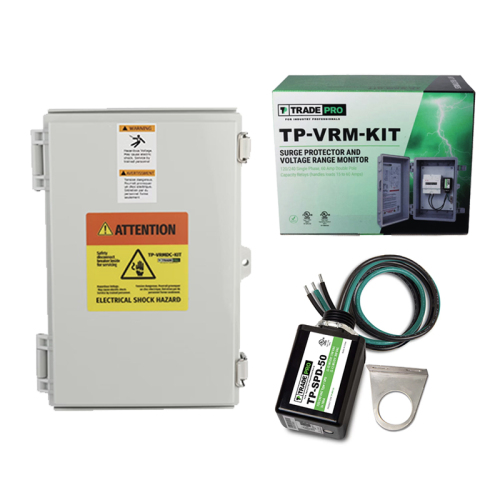
The TP-VRM-KIT pairs the TP-SPD-50 with a VRM60A voltage range monitor — all in a single NEMA 3R enclosure. The difference between Good and Better isn’t just more protection. It’s a different category of protection.

The voltage monitor watches incoming power continuously. If voltage swings too high or too low — conditions that can destroy a compressor quietly, over time — it automatically disconnects the equipment and resets once conditions normalize. No service call needed. No customer panic.

This is the right recommendation when your customer is in an area with inconsistent utility power, running a higher-end system, or simply wants to know you thought of everything. The all-in-one enclosure keeps the installation clean and professional.

Best for: Higher-efficiency systems, areas with known voltage fluctuation, customers who’ve had equipment problems before.

Best — TP-VRMDC-KIT

Built for the systems your customers are buying today.

Modern inverter-driven equipment — Daikin, Amana, GREE — is engineered for efficiency and communicating control. It’s also engineered with tight electrical tolerances. That’s what makes it perform. It’s also what makes it vulnerable.

The TP-VRMDC-KIT combines the RSH-VRM60A voltage range monitor and RSH-50 surge protector with a built-in 60-amp disconnect breaker, all in a NEMA 3R enclosure. One box. One connection point. Everything a premium install requires — and the disconnect is already there, which means you’re not running a separate step.

When you’re installing a $6,000–$10,000 system and the homeowner has just made a real investment in their home, this is the professional recommendation. It’s also the one that removes all the friction at inspection.

Best for: Inverter-driven systems, premium installs, new construction, any job where the equipment cost justifies complete protection.

Quick Reference

Good TP-SPD-50 Better TP-VRM-KIT Best TP-VRMDC-KIT
Surge Protection
Voltage Monitoring
Auto Disconnect/Reset
Built-In Disconnect Breaker
NEMA 3R Enclosure
Best For Every install Enhanced protection Modern inverter systems


One More Thing Worth Knowing

Surge protectors work best when they’re properly sized and grounded to a single-point ground. This isn’t optional — it’s the difference between a protector that performs and one that just looks like it does. If that’s not part of your standard install process, it should be.

The Professional Reason to Offer This on Every Job

You already know how to do the mechanical work. What surge protection gives you is a way to stand behind the full system — not just the equipment. Customers remember the contractor who thought ahead. They also remember the one who had to come back.

Including surge protection in every proposal means fewer callbacks, a stronger warranty story, and a tangible reason for the homeowner to say yes on the spot. The TP-VRMDC-KIT, in particular, is an easy add to any inverter system proposal because the value is obvious — and because the cost of not including it shows up in the first year of operation.

Ready to stock these? 

TRADEPRO® surge protection is available now through your local branch or directly through your shopping cart. If you’re not already building your proposals with SimpleProposal, this is a good time to start — add surge protection as a standard line item on every system quote and let the math close it for you.

We have the surge protection solutions you need in stock today!


How Hurricane Andrew Transformed HVAC Building Codes

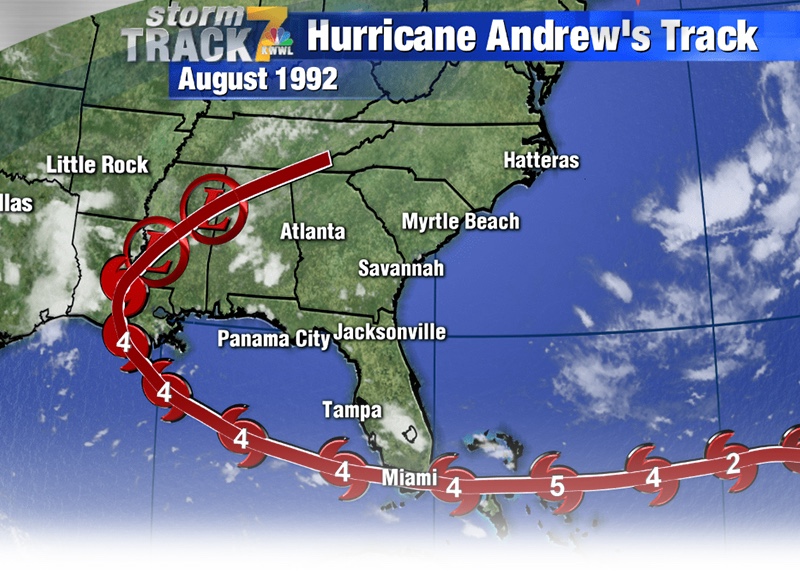
Hurricane Andrew Track

Hurricane Andrew, one of the most powerful and destructive storms in U.S. history, struck South Florida in August 1992. As a Category 5 hurricane, Andrew caused widespread devastation, leading to significant changes in building codes and construction practices. Among the many areas affected, HVAC systems saw notable improvements in resilience and safety standards. Let’s delve into how Hurricane Andrew reshaped the way we think about and secure our HVAC systems.

The Impact of Hurricane Andrew

Before Hurricane Andrew, many HVAC systems in South Florida were not designed to withstand the extreme winds and flying debris associated with such powerful storms. The hurricane’s 175 mph winds ripped air conditioning units from their mounts and severely damaged ductwork, leaving many homes and buildings without functional cooling systems in the sweltering aftermath.
Continue reading “How Hurricane Andrew Transformed HVAC Building Codes”

The Essential Safety Gear for HVAC Technicians: A Comprehensive Guide

HVAC Safety Gear

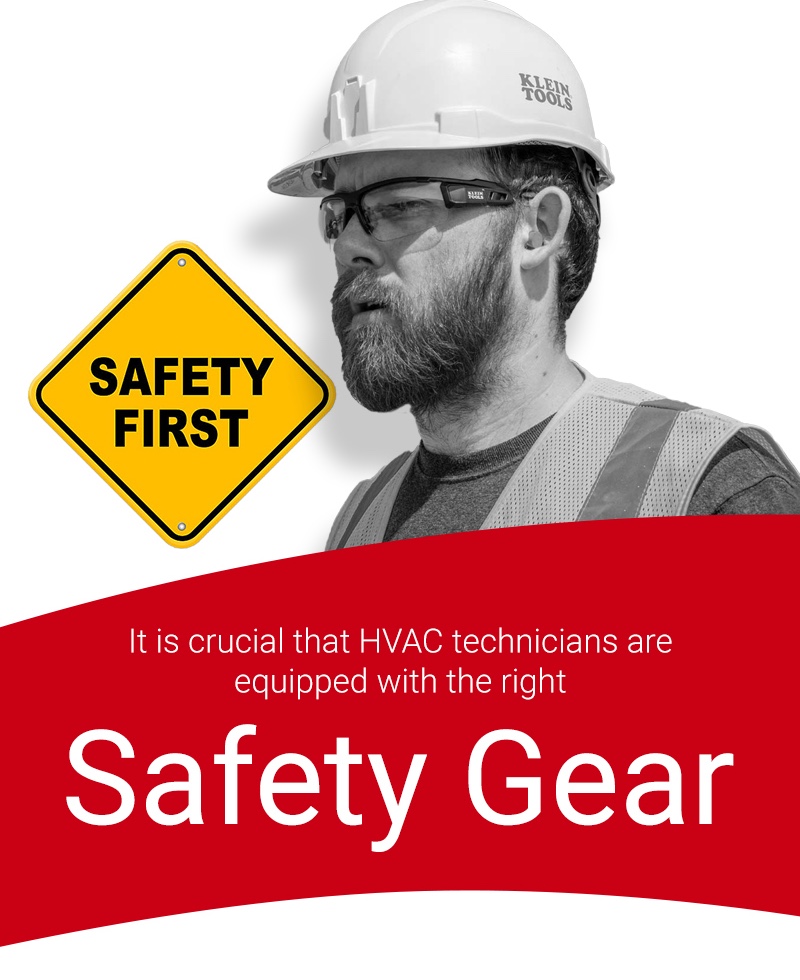
When it comes to the HVAC industry, safety should be paramount. Technicians often find themselves in challenging environments, working with electrical systems, high temperatures, and potentially hazardous materials. To ensure their safety and efficiency, it’s crucial that they are equipped with the right safety gear. In this blog post, we’ll explore the essential safety gear every HVAC technician should have and why it’s so important.

Flame-Resistant Clothing

Flame-resistant clothing is one of the most critical pieces of safety gear for HVAC technicians. Designed to provide an essential layer of protection against exposure to electrical components and flammable gases, FR clothing helps to minimize the risk of burns and other injuries. Continue reading “The Essential Safety Gear for HVAC Technicians: A Comprehensive Guide”

Why is R Often Added to HVAC?

HVAC Image

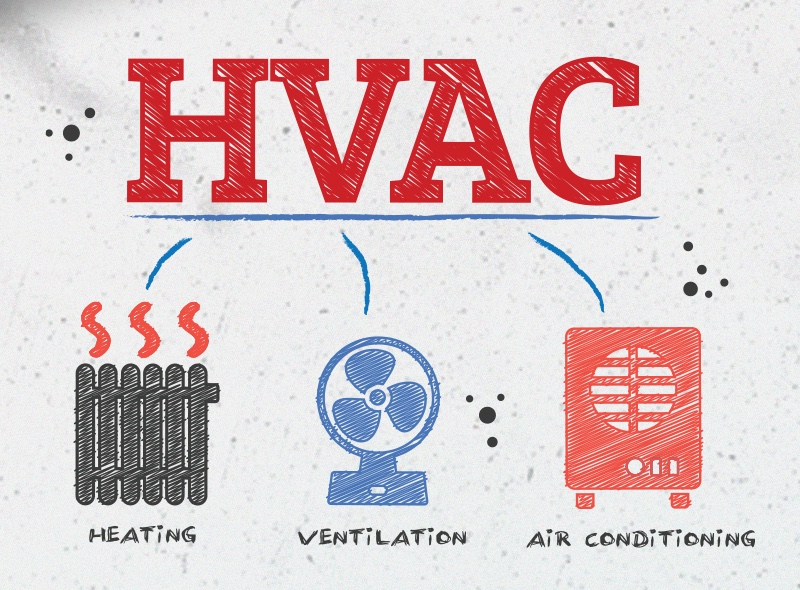
The term HVAC stands for Heating, Ventilation, and Air Conditioning. Sometimes an “R” is added for Refrigeration – HVACR, because the same principles that cool a home also keep a refrigerator cold.

Both an air conditioning system and refrigerator use the principles of refrigeration to remove heat and provide cooling. Continue reading “Why is R Often Added to HVAC?”

Grow Your HVAC Business with IAQ

Air purification devices remove biological and chemical contaminants, such as dust, pollen, mold, bacteria, viruses, smoke, and volatile organic compounds (VOCs) that cause odors. The result is cleaner, healthier, fresh smelling indoor air!  One of the best ways to expand your HVAC services and increase your revenue is by offering unique air purification products that address common concerns.

HOMEOWNER BENEFITS:

  • Reduction in the risk of respiratory infections and allergies by eliminating airborne pathogens and allergens
  • Enhanced performance and efficiency of their HVAC system by reduction of the load on the filters and coils
  • Extended lifespan of their HVAC system by preventing dust and dirt buildup on the components
  • Lower energy costs due to improved airflow

CONTRACTOR BENEFITS:

Continue reading “Grow Your HVAC Business with IAQ”

IAQ Selling Strategies

IAQ is a service that can be promoted on every single job. Own your customer’s comfort, and become their trusted HVAC provider, by taking a broader perspective of your customer’s home. Don’t just look at what the homeowner called you about. Your homeowner is never going to call you and say, “Hey, my air conditioning is not working, and oh by the way I have allergies and I was wondering if you could improve the air quality in my home.” That call is most likely never coming. So, use every homeowner visit as an opportunity to take a deeper look and educate them on the air quality of their home.

Continue reading “IAQ Selling Strategies”

Why Should I Care About IAQ?

Homeowners with Contractor

The shift of IAQ from being a want to a need put’s HVAC Contractors in a unique position of new opportunities for business growth. According to OnCall Air, In 2020, “contractors that offered an optional add-on, such as a dehumidifier, UV light…, saw (that) 1 in 5 consumers accept the recommended product and attach it to the sale.” Customers are looking for whole home IAQ solutions, it’s your job as the contractor to be educated on the causes and solutions out there.

Continue reading “Why Should I Care About IAQ?”

5 Pillars of Indoor Air Quality (IAQ)

Our 5 Pillars of IAQ are built to show solutions that can be offered to your customers, based on the IAQ issue. It’s important to first establish the cause of poor indoor air in a home or business before determining a solution for your customer. IAQ training can be key in making sure you and your employees have the tools needed to make informed decisions based on the IAQ issue at hand.

Continue reading “5 Pillars of Indoor Air Quality (IAQ)”