
The Callback You Didn’t See Coming
You installed a high-efficiency system six months ago. Clean job. Customer was happy. Then you get the call: control board is fried. Compressor acting up. Customer wants to know why.
You already know the answer. You just didn’t see it coming.
Power surges aren’t dramatic. Most of them aren’t lightning strikes. They’re the slow, invisible damage that builds up every time the A/C cycles on, every time the grid hiccups, every time a generator kicks in down the street. The electronics in today’s inverter-driven systems — the variable-speed motors, the communicating control boards, the ECM components — are not forgiving. They weren’t built to absorb that stress. They were built to run clean power. And in most residential installs, that’s not what they’re getting.
Here’s What That Callback Actually CostS You
Let’s run the numbers.
A replacement control board can run $300–$600 in parts alone. Add two hours of labor, a return trip, and the time you spent diagnosing — and you’re looking at $500–$900 out the door, much of it your own time. Then factor in the warranty call you have to make, the paperwork, and the customer who now has a question mark in their head about the system you installed.
Most manufacturer warranties don’t cover surge damage. That’s not fine print — that’s the exposure sitting on every install you complete without protection.
Now compare that to the cost of surge protection at install: $50–$150 depending on the level. That math isn’t close.
Contractors who include surge protection in every proposal aren’t just upselling. They’re protecting their own time, their own reputation, and their own callback rate.
Matching the Right Protection to the Right Job
Not every customer needs the same solution. TradePro’s surge protection lineup gives you a clear, defensible recommendation for every install — from budget-conscious homeowners to premium inverter system buyers.
Good — TP-SPD-50
Baseline protection. Every install deserves this.
The TP-SPD-50 is a Single Phase Type 1 surge protector. It handles what causes most equipment damage day-to-day: voltage spikes from A/C cycling, utility fluctuations, nearby motors, and generators. Compact. Straightforward to install. No reason not to put one on every job.
When a homeowner says they don’t want to spend extra, this is your answer. The cost is low enough that most customers won’t push back — and it closes the loop on the most common cause of premature board failure.
Best for: Any residential install where the customer wants baseline protection at a practical price point.
Better — TP-VRM-KIT
When you’re protecting a serious investment.
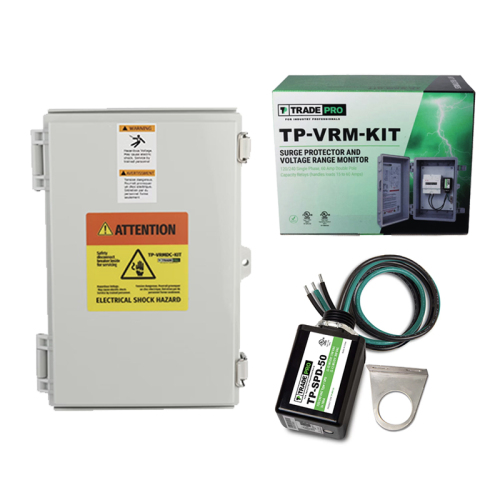
The TP-VRM-KIT pairs the TP-SPD-50 with a VRM60A voltage range monitor — all in a single NEMA 3R enclosure. The difference between Good and Better isn’t just more protection. It’s a different category of protection.
The voltage monitor watches incoming power continuously. If voltage swings too high or too low — conditions that can destroy a compressor quietly, over time — it automatically disconnects the equipment and resets once conditions normalize. No service call needed. No customer panic.
This is the right recommendation when your customer is in an area with inconsistent utility power, running a higher-end system, or simply wants to know you thought of everything. The all-in-one enclosure keeps the installation clean and professional.
Best for: Higher-efficiency systems, areas with known voltage fluctuation, customers who’ve had equipment problems before.
Best — TP-VRMDC-KIT
Built for the systems your customers are buying today.
Modern inverter-driven equipment — Daikin, Amana, GREE — is engineered for efficiency and communicating control. It’s also engineered with tight electrical tolerances. That’s what makes it perform. It’s also what makes it vulnerable.
The TP-VRMDC-KIT combines the RSH-VRM60A voltage range monitor and RSH-50 surge protector with a built-in 60-amp disconnect breaker, all in a NEMA 3R enclosure. One box. One connection point. Everything a premium install requires — and the disconnect is already there, which means you’re not running a separate step.
When you’re installing a $6,000–$10,000 system and the homeowner has just made a real investment in their home, this is the professional recommendation. It’s also the one that removes all the friction at inspection.
Best for: Inverter-driven systems, premium installs, new construction, any job where the equipment cost justifies complete protection.
Quick Reference
|
|
Good TP-SPD-50 | Better TP-VRM-KIT | Best TP-VRMDC-KIT |
| Surge Protection | ✅ | ✅ | ✅ |
| Voltage Monitoring | ❌ | ✅ | ✅ |
| Auto Disconnect/Reset | ❌ | ✅ | ✅ |
| Built-In Disconnect Breaker | ❌ | ❌ | ✅ |
| NEMA 3R Enclosure | ❌ | ✅ | ✅ |
| Best For | Every install | Enhanced protection | Modern inverter systems |
One More Thing Worth Knowing
Surge protectors work best when they’re properly sized and grounded to a single-point ground. This isn’t optional — it’s the difference between a protector that performs and one that just looks like it does. If that’s not part of your standard install process, it should be.
The Professional Reason to Offer This on Every Job
You already know how to do the mechanical work. What surge protection gives you is a way to stand behind the full system — not just the equipment. Customers remember the contractor who thought ahead. They also remember the one who had to come back.
Including surge protection in every proposal means fewer callbacks, a stronger warranty story, and a tangible reason for the homeowner to say yes on the spot. The TP-VRMDC-KIT, in particular, is an easy add to any inverter system proposal because the value is obvious — and because the cost of not including it shows up in the first year of operation.
Ready to stock these?
TRADEPRO® surge protection is available now through your local branch or directly through your shopping cart. If you’re not already building your proposals with SimpleProposal, this is a good time to start — add surge protection as a standard line item on every system quote and let the math close it for you.
We have the surge protection solutions you need in stock today!